
The exercise was aimed at validating joint plans for strategic airlift of specialised forces employing IAF's fixed and rotary wing platforms by landing and dropping in designated areas for undertaking kinetic actions, they said.
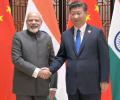
The Chinese and the Indian troops were engaged in a standoff for 73 days in Doklam.

Less than a month after the historic visit of Prime Minister Narendra Modi to the US, a Congressional senatorial Committee has passed a resolution recognising Arunachal Pradesh as an integral part of India.
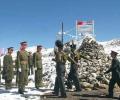
The two sides have already held at least 12 rounds of talks between local commanders and three rounds of talks between major general-rank officials but no positive outcome came out from the discussions, they said.

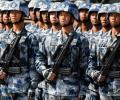
Chinese President Xi Jinping has bestowed special honours on a PLA battalion posted in Tibet close to Arunachal Pradesh for its "outstanding performance in safeguarding borders".
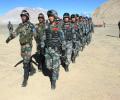
The last time the Chinese military had taken Indian soldiers captive was in July 1962 after a clash in Galwan Valley.

Chinese foreign ministry spokesman Geng Shuang told a media briefing in Beijing that "at the moment the situation in the boundary region between China and India is overall stable and controllable".
The United States has recognised that territory (Arunachal Pradesh) for a long time (as an integral part of India), White House Press Secretary Karine Jean-Pierre said.
'I strongly urge China to respect norms and use diplomacy and existing mechanisms to resolve its border questions with India'
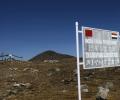
China's Ministry of Civil Affairs on Sunday released standardised names of 11 places for Arunachal Pradesh, which it calls "Zangnan, the southern part of Tibet".
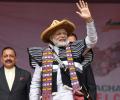
New Delhi's reaction came in response to Beijing announcing Chinese names for 11 more places in Arunachal Pradesh which the neighbouring country claims as southern part Tibet.

The last conversation between the two leaders was on April 4 on the issue of hydroxychloroquine.

The 17th Gyalwang Karmapa Ogyen Trinley Dorje last week visited Arunachal Pradesh, which China claims as a part of southern Tibet.
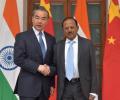
The two sides have already held 21 rounds of talks under the framework of SR dialogue which was set up to find an early solution to the border dispute.
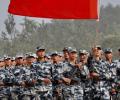
The Chinese action followed 'India's recent, illegal construction of defence facilities across the border into Chinese territory in the Galwan Valley region', a write-up in the state-run Global Times tabloid said, quoting unnamed military sources.

In Tokyo, hundreds of Japanese citizens came out on the streets to express solidarity with the oppressed people of Tibet, Xinjiang, Mongolia, Hong Kong and Taiwan.

'The need of the hour is to build on the positives and control the negatives,' says Colonel (Dr) Anil A Athale (retd).

Dai Bingguo, who served as the China's boundary negotiator with India from 2003 to 2013, told Chinese media, "If the Indian side takes care of China's concerns in the eastern sector of their border, the Chinese side will respond accordingly and address India's concerns elsewhere."

Sticking to its stand that McMahon Line on India-China boundary is "illegal", China on Monday said it is ready to work with India to resolve the vexed border issue at an early date through "friendly consultations" to create more favourable conditions for bilateral ties.

China said that after this incident both sides are in communication and coordination on the matter through diplomatic and military channels.
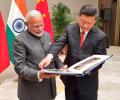
'In South Asia, unlike Southeast, East, or Central Asia, there is a natural hegemon: India. China cannot cast it aside easily'

The ministry of external affairs said India has conveyed its "consistent position" on the issue to China on several occasions.

The Indian side is expected to present specific proposals at the talks to deescalate tension in Pangong Tso, Galwan Valley and Demchok -- the three areas in eastern Ladakh where the two sides have been on a bitter standoff for last one month, the sources said.

India and China have so far held 19 rounds of talks to resolve the boundary dispute.
Singh said a meeting between senior Indian and Chinese military leaders has been scheduled for June 6 even as he asserted that India is not going to back off from its position. Asked about the current situation in sensitive areas in eastern Ladakh, he said Chinese have come up to what they claim is their territory while Indians believed it is theirs.

Defence Minister Rajnath Singh on Saturday asserted that the government will not allow India's pride to be hurt under any circumstances even as he said bilateral talks were on at military and diplomatic levels to resolve the row.

Bagchi said this when asked to comment on remarks by a Chinese diplomat that the situation in the India-China border areas is stable.
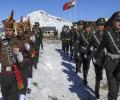
The MEA spokesperson did not reply to questions like whether the US had approached India with the offer, whether New Delhi has communicated its response over it to Washington, DC or whether the Trump administration has been briefed about the current standoff between Chinese and Indian soldiers in eastern Ladakh.
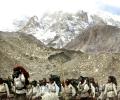
The Indian Army will continue to maintain its aggressive posturing in all disputed areas in eastern Ladakh and will not back off till status quo is maintained, sources said.

China said it was committed to peace and tranquility at the border areas.

At least a couple of Chinese military helicopters were spotted flying close to the un-demarcated Sino-India border in the area after the fierce face-off on May 5 following which a fleet of Sukhoi-30 jets of the Indian Air Force too carried out sorties there, the sources said.

Army chief General Naravane said the ongoing dialogue will sort out all the perceived differences between the two countries.
The talks between the two armies are going to be held this week at multiple locations including Patroling point 14 (Galwan area), Patrolling point 15, and Hot Springs area, top government sources said.

The Chinese media has accused India of using the Dalai Lama card to deal with China's growing economic and political influence in South Asia and warned New Delhi of "severe consequences" if it hosted the Tibetan spiritual leader in a "disputed" area in Arunachal Pradesh.
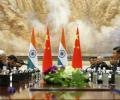
Prime Minister Narendra Modi began a three-day visit to China from this north west city on Thursday, the hometown of Chinese President Xi Jinping with whom he held "very substantive" discussions focussing on strengthening of mutual trust and the boundary issue.
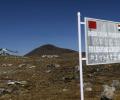
Projecting the mining operations as part of China's move to take over Arunachal Pradesh, the report said 'people familiar with the project say the mines are part of an ambitious plan by Beijing to reclaim South Tibet'.

The focus of the talks will be to ensure mutual development and expanding overall ties, diplomatic sources said.
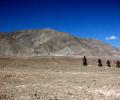
While the de-escalation process was underway, a violent face-off took place on Monday night between Indian and Chinese troops leading to the death of 20 Indian soldiers.

The enhancement of combat capability by the two armies in the region came even as both the countries continued their efforts to resolve the dispute through talks at military and diplomatic levels.
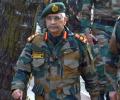
The commanders will also deliberate on the overall situation in Jammu and Kashmir besides delving into issues having national security implications, they said. However, the main focus will be on the situation in eastern Ladakh where Indian and Chinese troops are locked in an eyeball-to-eyeball face-off in Pangong Tso, Galwan Valley, Demchok and Daulat Beg Oldie, the sources said.
